0 views
Share this clip
Roots of Blues Big Joe Williams „His Spirit Lives On
Know someone who'd love this clip?
Share it with friends and fellow fans.
Share this clip
Know someone who'd love this clip?
Share it with friends and fellow fans.
„His Spirit Lives On (Joe Williams) Recorded: Chicago, 1945 Big Joe Williams (g) (vcl) Clifford Dinwiddie (w) Born in Crawford, Mississippi, Williams as a youth began wandering across the United States busking and playing stores, bars, alleys and work camps. In the early 1920s he worked in the Rabbit Foot Minstrels revue and recorded with the Birmingham Jug Band in 1930 for the Okeh label. In 1934 he was in St. Louis, where he met record producer Lester Melrose who signed him to a contract with Bluebird Records in 1935. He stayed with Bluebird for ten years, recording such blues hits as "Baby, Please Don't Go" (1935) and "Crawlin' King Snake" (1941), both songs later covered by many other performers. He also recorded with other blues singers, including John Lee "Sonny Boy" Williamson, Robert Nighthawk and Peetie Wheatstraw. Williams remained a noted blues artist in the 1950s and 1960s, with his guitar style and vocals becoming popular with folk-blues fans. He recorded for the Trumpet, Delmark, Prestige and Vocalion labels, among others. He became a regular on the concert and coffeehouse circuits, touring Europe and Japan in the late 1960s and early 1970s, and performing at major U.S. Festivals. Big Joe's guitar playing is decidedly in the Delta Blues style, and yet is unique. He played driving rhythm and virtuosic lead lines simultaneously and sang over it all. He played with picks both on his thumb and index finger, plus his guitar was very heavily modified. Williams added a rudimentary electric pick-up, whose wires coiled all over the top of his guitar. He also added three extra strings, creating unison pairs for the first, second and fourth strings. His guitar was usually tuned to Open G, like such: (D2 G2 D3D3 G3 B3B3 D4D4), with a capo placed on the second fret to set the tuning to the key of A. During the 1920s and 1930s, Big Joe had gradually added these extra strings in order to keep other guitar players from being able to play his guitar. In his later years, he would also occasionally use a 12-string guitar with all strings tuned in unison to Open G. It is little known that Big Joe sometimes tuned a six-string guitar to an interesting modification of Open G. In this modified tuning, the bass D string (D2) was replaced with a .08 gauge string and tuned to G4. The resulting tuning was (G4 G2 D3 G3 B3 D4), with the G4 string being used as a melody string by Big Joe. This tuning was used exclusively for slide playing. He was inducted into the W. C. Handy Blues Hall of Fame on October 4, 1992. He died December 17, 1982 in Macon, Mississippi. Big Joe is buried in private cemetery outside Crawford near the Lowndes County line. His headstone was primarilly paid for by friends and partially funded by a collection taken up among musicians at Clifford Antone's night club in Austin, Texas, organized by California music writer Dan Forte, and erected through the Mt. Zion Memorial Fund on October 9, 1994. Harmonica virtuoso and one time touring companion of Williams Charlie Musselwhite delivered the eulogy at the unveiling. Williams' headstone epitaph, composed by Dan Forte, proclaims him "King of the 9 String Guitar".
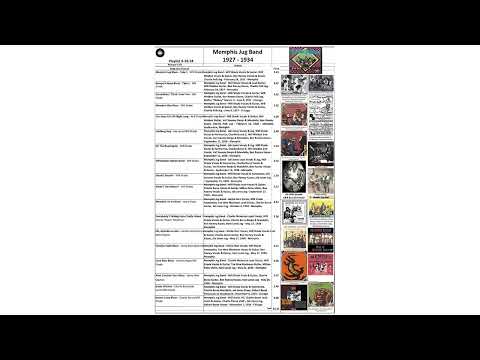
American musical group active from the mid-1920s to the late 1950s. The band featured harmonica, kazoo, fiddle and mandolin or banjolin, backed by guitar, piano, washboard, washtub bass and jug. They played slow blues, pop songs, humorous songs and upbeat dance numbers with jazz and string band flavors. The band made the first commercial recordings in Memphis, Tennessee, and recorded more sides than any other prewar jug band.
More about Jug band→Added
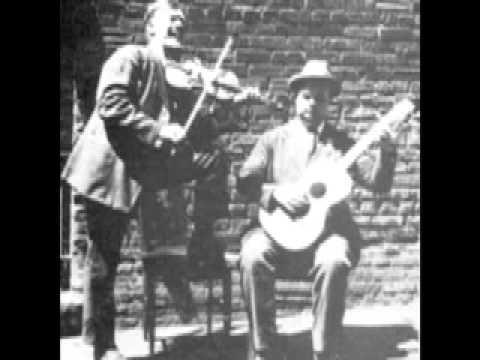 2:52
2:52R.E.M., Head, Iration, Bob Dylan, Y&T
 2:21
2:21Billy Sheehan, Y&T
 2:20
2:20Carson Robison
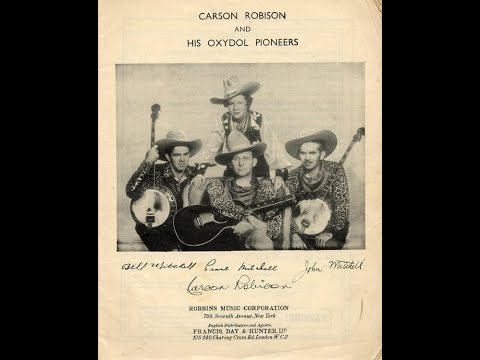 2:47
2:47Carson Robison
 2:11
2:11Jug band, Ride, Bobby Bare, Y&T
 2:28
2:28Jug band
 46:44
46:44Jug band, R.E.M., P.O.D.
 2:31
2:31Jug band, Will Weldon, Will Shade, Charlie Burse