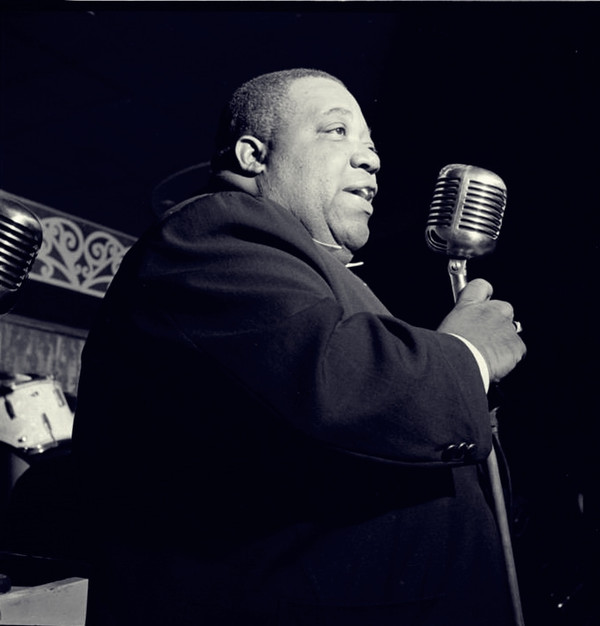
Jimmy Rushing — Rare Footage & Clips
Jimmy Rushing, the legendary vocalist of Count Basie's Orchestra, left an indelible mark on the world of jazz with his powerful, soulful voice and commanding stage presence. As we delve into the archives of DeepCutsArchive, it becomes clear that Rushing's legacy extends far beyond his tenure with one of the most iconic big bands in history.
Born James Andrew Rushing on August 26, 1901, in Oklahoma City, Oklahoma, he began his musical journey at a young age. According to his own account, Rushing's first time singing in front of an audience was in 1924, when he was invited by Carlyn Williams to take the mic at a club where he was playing piano. This pivotal moment marked the beginning of a storied career that would span over four decades.
Rushing's early days were spent with Walter Page's Blue Devils (1927) and Bennie Moten's band (1929), before joining Count Basie's successor in 1935, following Moten's untimely passing. It was during this period that Rushing earned the moniker "Mr. Five by Five," a nod to his distinctive physical presence – as described in the popular song of 1942, which became a hit for Harry James and others.
One of the most significant aspects of Rushing's career is his ability to adapt and thrive within various musical settings. His impressive vocal range, spanning from baritone to tenor, allowed him to navigate seamlessly between different styles, from the blues shouter tradition to more refined jazz arrangements. This versatility is evident in his performances with Count Basie's Orchestra, where he would often project his voice over the horns and reeds, creating a sense of drama and tension.
The archives at DeepCutsArchive hold several rare clips that showcase Rushing's remarkable talent. One such clip features him performing "Five Feet of Soul," a song from his 1956 album of the same name. In this rendition, Rushing's voice soars with an effortless ease, conveying the emotional depth and nuance that made him a beloved figure among jazz aficionados.
Another notable performance is found on the 1957 album "The Jazz Odyssey Of James Rushing Esq.," where he tackles the classic standard "Don't Get Around Much Anymore." Here, Rushing's voice takes center stage, navigating the intricate harmonies and syncopated rhythms with a level of sophistication that belies his rough-around-the-edges persona.
Rushing's collaborations with other musicians are also well-represented in the archives. A clip from "Cat Meets Chick" (1956), a joint effort with pianist Oscar Peterson, showcases their effortless chemistry as they trade vocal and instrumental licks on the tune "Honeysuckle Rose." This performance is a testament to Rushing's ability to connect with his fellow musicians, creating an atmosphere of camaraderie and shared creativity.
Throughout his career, Rushing released several albums that have become cornerstones of jazz history. His 1961 album "Bessie - Clara - Mamie & Trixie (The Songs They Made Famous)" is a particularly notable example, featuring his interpretations of classic songs associated with the legendary female vocalists Bessie Smith, Clara Ward, Mamie Smith, and Trixie Friganza.
Rushing's later years saw him continuing to tour and record, albeit at a slower pace. His 1967 album "Gee, Baby, Ain't I Good To You" features his take on the classic blues standard, while "Blues and Things" (1968) showcases his ability to adapt to changing musical trends.
In recent years, Rushing's legacy has been celebrated through various reissues and compilations. The 1988 album "The You and Me That Used to Be," released posthumously, features a selection of his most notable performances from throughout his career. Similarly, the 1991 compilation "The Essential Jimmy Rushing" serves as a comprehensive overview of his artistry, featuring tracks from across his discography.
As we explore the archives at DeepCutsArchive, it becomes clear that Jimmy Rushing's impact on jazz extends far beyond his own performances. He was an instrumental figure in shaping the sound and style of Count Basie's Orchestra, influencing generations of musicians to come. His legacy continues to inspire new generations of artists, reminding us of the transformative power of music to transcend time and circumstance.
In the clips that follow, we invite you to experience Rushing's remarkable talent firsthand, as he soars through the jazz canon with a voice that is at once powerful, expressive, and uniquely his own.
Curated from public records and music databases.