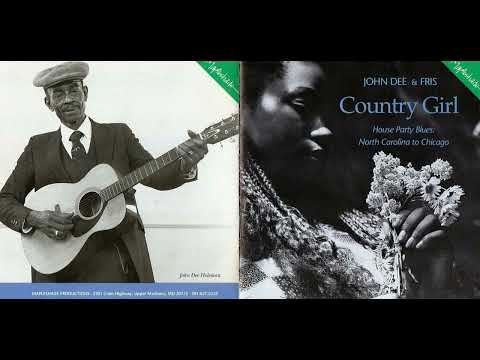
John Dee Holeman Country Girl
John Dee Holeman (April 4, 1929 – April 30, 2021) was an American Piedmont blues guitarist, singer, and songwriter. His music includes elements of Texas blues, R&B and African-American string-band music. In his younger days he was also known for his proficiency as a buckdancer. Holeman was born in Hillsborough, North Carolina. on April 4, 1929. He was raised on a farm in Orange County. He learned to play the guitar, and listened to traveling bluesmen from other parts of the South, as well as on the radio. Drawing inspiration from Blind Boy Fuller, he began singing and playing guitar at local parties and other community events by the time he was in his mid-teens. He went on to purchase his first electric guitar during his mid-twenties. Holeman relocated to Durham, North Carolina, in 1954, where he played with the pianist Fris Holloway. The duo became adept at the Juba dance, also known as the hambone or buckdance, which he had earlier learned at country dances. During his working lifetime, Holeman had full-time employment as a construction worker, and music was a part-time pursuit. However, he was able to tour in the United States and overseas in the 1980s, including performances at Carnegie Hall, and abroad on behalf of the United States Information Agency's Arts America program. He played at the 42nd National Folk Festival at Wolf Trap, Virginia, in 1980. He performed yearly at the Black Banjo Festival, in Boone, North Carolina. His first album, Bull City After Dark, was nominated for a W. C. Handy award (a predecessor of the Blues Music Awards). He recorded the album Bull Durham Blues in 1988, which featured Taj Mahal. It was re-released on the Music Maker label in 1999. Also in 1988, the National Endowment for the Arts presented Holeman with a National Heritage Fellowship. Holeman was presented with the North Carolina Folk Heritage Award in 1994. A song Holeman wrote, "Chapel Hill Boogie", was featured on the 2007 Grammy Award–nominated album 10 Days Out: Blues from the Backroads, recorded by Kenny Wayne Shepherd. In 2007, Music Maker issued the album John Dee Holeman & the Waifs Band, on which Holeman was backed by the Waifs, an Australian folk-rock group. He played several shows in 2018 with Cajun/Zydeco musician Mel Melton in Durham. Holeman was married to Joan until his death. He died on April 30, 2021, at the age of 92.
About This Footage
The recently uploaded clip "John Dee Holeman Country Girl" (2021) offers a rare glimpse into the life of John Dee Holeman, an American Piedmont blues guitarist, singer, and songwriter who left an indelible mark on the music world. This 3:54-minute footage is a valuable addition to the archive, providing insight into the artist's performance style and artistry.
Born in 1929 in Hillsborough, North Carolina, Holeman was raised on a farm where he learned to play the guitar and drew inspiration from traveling bluesmen and Blind Boy Fuller. His music career spanned over five decades, during which he performed at iconic venues such as Carnegie Hall and toured internationally with the United States Information Agency's Arts America program.
The clip itself is a testament to Holeman's skill as a guitarist and singer. With his unique blend of Piedmont blues, Texas blues, R&B, and African-American string-band music, he weaves a sonic tapestry that is both nostalgic and forward-thinking. His fingerpicking style, characteristic of the Piedmont blues tradition, is on full display here.
What makes this footage particularly notable is its rarity. As Holeman's career spanned from the 1950s to his passing in 2021, there are few documented performances available for public consumption. This clip, therefore, serves as a vital piece of cultural and musical history, allowing audiences to experience the artist's artistry firsthand.
Holeman's contributions to American music go beyond his own performances. He was an influential figure in the Piedmont blues revival of the 1980s, which helped to popularize this unique genre worldwide. His collaborations with other artists, such as Taj Mahal on the album Bull Durham Blues (1988), further cemented his reputation as a master musician.
The National Endowment for the Arts' recognition of Holeman's work in 1988, when he received a National Heritage Fellowship, is a testament to his significance within American cultural heritage. Similarly, his nomination for a W.C. Handy award and receipt of the North Carolina Folk Heritage Award in 1994 underscore the impact of his music on both local and national levels.
In "John Dee Holeman Country Girl," we are privileged to witness the artist's performance at its core – raw, unadulterated, and full of life. This clip serves as a poignant reminder of the importance of preserving our cultural heritage through documentation and sharing it with future generations. As such, it is an invaluable addition to any archive or collection dedicated to blues music and American cultural history.
Curated from public records and music databases.
About John Dee Holeman
John Dee Holeman (April 4, 1929 – April 30, 2021) was an American Piedmont blues guitarist, singer, and songwriter. His music includes elements of Texas blues, R&B and African-American string-band music.
More about John Dee Holeman→Added
Know someone who'd love this clip?
Share it with friends and fellow fans.