0 views
Share this clip
Airvault 2011-Huun Huur Tu (3)
Know someone who'd love this clip?
Share it with friends and fellow fans.
Share this clip
Know someone who'd love this clip?
Share it with friends and fellow fans.
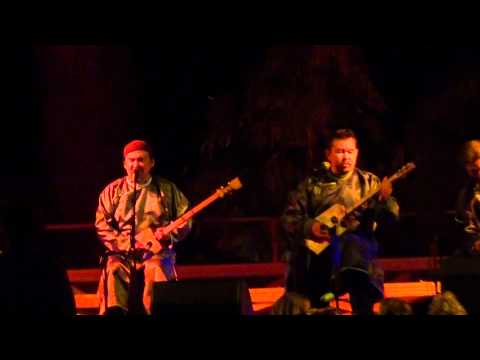
Masters of the throat singing style of xoomei, in which a vocalist produces two or three notes simultaneously, the group has been warmly by an international following. According to Jazz Times, "a rustic joyousness and unadulterated expresiveness come out of these musicians". Analyzing Huun-Huur-Tu's music, The Chicago Tribune, wrote, 'it is unfamiliar yet very accessible, an other-worldly but deeply spiritual music that is rooted in the sound of nature". Dirty Linen took a similar view, claiming, "this music is both very spiritual and down to earth, grounded in a strong sense of place, yet its appeal is universal." In addition to recording their own albums, the members of Huun-Huur-Tu have contributed their unique vocals to albums and/or performances by Frank Zappa, The Chieftains, Johnny "Guitar" Watson, The Kronos Quartet and L. Shankar and Ry Cooder's soundtrack of the film, Geronimo. Their on-going collaboration with Angelite, the Bulgarian Woman's Choir under the direction of Mikhail Alperin, has yielded two memorable albums -- Fly, Fly My Sadness in 1994 and Mountain Tale in 1998. Although its name translates literally as "sun propeller", Huun-Huur-Tu represents much more. In a 1994 interview, founding percussionist Alexander Bapa explained, "(the name of the band refers to) the vertical seperation of light rays that are often seen on the grasslands just after sunrise or just before sunset". Initially named "Kungurtuk", Huun-Huur-Tu came together, in 1992, to play "the old and forgotten songs". Founding members Sasha and Sayan Bapa and Kaigalool Khovalyg had previously performed a state-sanctioned ensemble during the Soviet regime. Although Tuvan music had traditionally been performed by a solo singer or instrumentalist, the group sound of Huun-Huur-Tu set them apart. Huun-Huur-Tu has experienced several personnel changes. Original member Anatoli Kuular left to form a new band, Yat-Kha, in late 1993, and was replaced by Anatoli Kuular, a master of the borbangnadyr style of singing and a virtuosic player of the mouth harp (xomuz) and byzanchi. Percussionist Alexander Bapa left, in 1995, to become a producer in Moscow, and was replaced by Alexander Siraglar, a sygyt singer, string player and precussionist. ~ Craig Harris
The Chieftains were a traditional Irish folk band formed in Dublin, Ireland, in 1962, by Paddy Moloney, Seán Potts and Michael Tubridy. Their sound, which is almost entirely instrumental and largely built around uilleann pipes, has become synonymous with traditional Irish music. They are regarded as having helped popularise Irish music around the world. They have won six Grammy Awards during their career and they were given a Lifetime Achievement Award at the 2002 BBC Radio 2 Folk Awards. Some m...
More about The Chieftains→Added
 11:57
11:57The Red Clay Strays
 5:51
5:51 3:55
3:55Elvis Costello
 1:19
1:19Walker Hayes
 1:01
1:01The Chieftains, The Sound, L.A.B., Seamus Egan, Matt Molloy, Concert, Music festival, Cher, Y&T
![Thumbnail for Huun Huur Tu - Altai Sayan Tandy-Uula [Full album] by The Chieftains, Sayan Bapa, Frank Zappa, Kaigal-ool Khovalyg, Huun-Huur-Tu, Radik Tülüsh](https://img.youtube.com/vi/XIrdoGK0-xg/hqdefault.jpg) 42:48
42:48The Chieftains, Sayan Bapa, Frank Zappa, Kaigal-ool Khovalyg, Huun-Huur-Tu, Radik Tülüsh
 3:48
3:48The Chieftains, Sayan Bapa, Frank Zappa, The Sound, L.A.B., Johnny "Guitar" Watson, Kaigal-ool Khovalyg, The Band, Ry Cooder, Huun-Huur-Tu, Y&T
 3:00
3:00The Chieftains, Sayan Bapa, Frank Zappa, The Sound, L.A.B., Johnny "Guitar" Watson, Kaigal-ool Khovalyg, The Band, Ry Cooder, Huun-Huur-Tu, Y&T