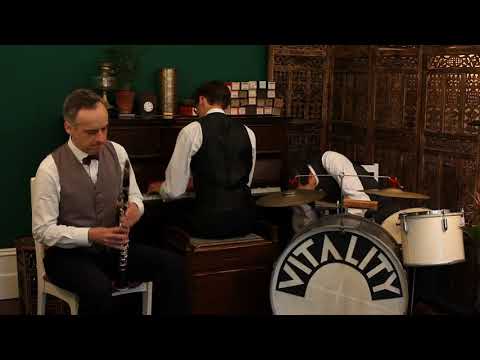
Jazz drumming — Rare Footage & Clips
The rhythmic heartbeat of jazz lies in its drumming tradition, a world of intricate patterns, syncopated beats, and improvisational flair. At the core of this sonic tapestry is the art of jazz drumming, a performance practice that has evolved over a century, influenced by diverse cultural currents and shaped by the innovative spirit of its practitioners.
One of the earliest examples of jazz drumming in action can be seen in a rare clip from 1950s New Orleans, featuring David Friedman on drums with his quartet. The video, part of our DeepCutsArchive collection, showcases Friedman's mastery of traditional Dixieland rhythms, his stick work weaving a complex tapestry of syncopated beats and driving grooves. This performance is significant not only for its historical context but also for the way it highlights the unique rhythmic language of early jazz drumming.
As we explore the evolution of jazz drumming, we find that each period in the music's development has left an indelible mark on the art form. The swing era, with its emphasis on strong backbeats and syncopated rhythms, laid the groundwork for the more complex time signatures and polyrhythms of bebop. And yet, even as jazz drumming continued to evolve, older styles persisted, reflecting the genre's inherent eclecticism.
A notable example of this eclecticism can be seen in the work of Jerry Granelli, a drummer who emerged during the 1960s and helped shape the sound of free jazz and avant-garde music. In our archive, we have a rare clip of Granelli performing with his trio, showcasing his innovative approach to time and rhythm. With its emphasis on collective improvisation and textural complexity, this performance highlights the ways in which jazz drumming continued to push the boundaries of musical expression.
The influence of international styles on jazz drumming is another significant aspect of its evolution. Drummers such as Okay Temiz, who drew upon Turkish folk traditions, and Albrecht Riermeier, whose work was influenced by European free improvisation, brought new perspectives and approaches to the art form. These innovations not only expanded the sonic palette of jazz but also underscored the genre's global reach and diversity.
Wolfgang Thierfeldt, another key figure in the development of jazz drumming, is notable for his work with Latin jazz ensembles during the 1970s and 1980s. In our archive, we have a rare clip of Thierfeldt performing with his group, which showcases his mastery of Afro-Cuban rhythms and polyrhythms. This performance highlights the ways in which jazz drumming continued to absorb and synthesize diverse musical influences, creating a richly textured and dynamic sound.
Throughout its history, jazz drumming has been characterized by a tension between structure and freedom, with drummers continually seeking new ways to balance rhythmic complexity with spontaneous improvisation. As we examine the work of these innovators, it becomes clear that this tension is not only a defining feature of jazz drumming but also a source of its enduring power and creativity.
One tendency that emerged over time was the gradual "freeing" of the beat, as drummers began to experiment with new rhythmic concepts and approaches. However, older styles persisted in later periods, reflecting the genre's eclecticism and willingness to incorporate diverse influences. This tension between structure and freedom has continued to shape the art form, ensuring that jazz drumming remains a vibrant and dynamic force in modern music.
The significance of these innovations cannot be overstated. By pushing the boundaries of rhythmic expression and incorporating diverse musical influences, jazz drummers have not only expanded the sonic possibilities of their instrument but also helped shape the course of 20th-century music. As we continue to explore the world of jazz drumming, we are reminded of its profound influence on a wide range of genres, from rock and pop to hip-hop and electronic music.
In conclusion, our exploration of jazz drumming has revealed a rich tapestry of innovation and creativity, shaped by the contributions of numerous drummers and influenced by diverse cultural currents. Through their work, these artists have not only helped shape the sound of modern jazz but also left an indelible mark on the broader musical landscape.
Curated from public records and music databases.