0 views
Share this clip
Know someone who'd love this clip?
Share it with friends and fellow fans.
Share this clip
Know someone who'd love this clip?
Share it with friends and fellow fans.
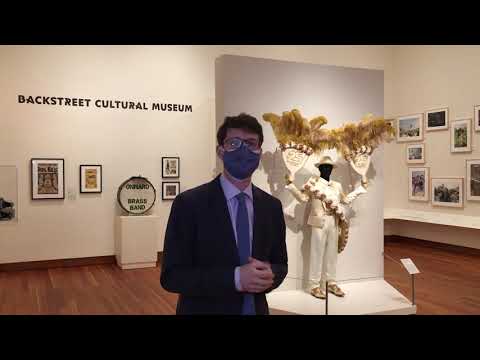
In this clip from a 1983 interview of Theodore Emile “Bo” Dollis (1944–2015), Big Chief of the Wild Magnolias, the chief describes changes in the traditions of Mardi Gras Indians and the suits that they make. A Mardi Gras Indian suit is more than a costume; wearers often describe wearing the suit and going out on Mardi Gras Day as a transformative and spiritual experience. The suit is both a work of art and a vehicle for preserving a culture of resistance, improvisation, and resilience. Each Indian suit has several sections with beaded decoration surrounded by colorful feathers and trim. The central, hand-beaded tapestries depict historic and cultural scenes, animals, people, or abstract geometry, with styles varying by neighborhood tribe. Each suit takes about a year to produce but is worn only three times: on Mardi Gras Day, on St. Joseph’s Day (March 19), and at the large gathering of tribes called Super Sunday (traditionally in late March). Film footage by Jules Cahn (1916–1995), a filmmaker and photographer whose work documented and promoted the arts and culture of New Orleans, provides the backdrop for Dollis’s commentary. Cahn photographed and filmed second line parades and Mardi Gras Indians and was a proponent of local artists, such as folk painter Sister Gertrude Morgan. Cahn’s film and photography collection was donated to The Historic New Orleans Collection by his family and is one of the most popular archives for visual materials related to New Orleans culture. This video was originally featured in THNOC’s award-winning 2022 exhibition Making Mardi Gras. 💜 💚 💛 More MARDI GRAS from THNOC 💜 💚 💛 🎥1970s Black Masking Indians on St. Joseph’s Night: https://youtu.be/CSYMUdR1ADY 🎨 The Breadth of Carnival Artistry in Nine Photographs: https://www.hnoc.org/publications/first-draft/breadth-carnival-artistry-nine-photographs 📚 🔍 FURTHER READING and RESOURCES 📓How to Preserve Black Masking Indian Suits: https://www.hnoc.org/publications/first-draft/preserving-pretty-new-resource-helps-preserve-black-masking-indian-suits © The Historic New Orleans Collection 2023 All rights reserved. No part of this video may be reproduced or transmitted in any form or by any means whatsoever without express written permission from The Historic New Orleans Collection.
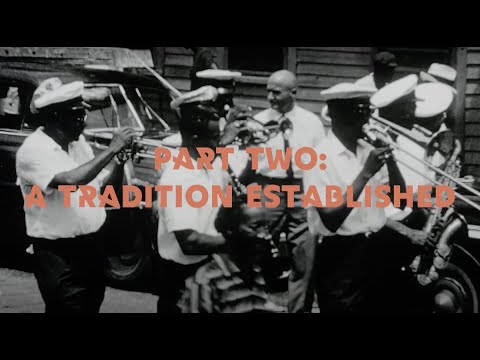
The second line is a tradition in parades organized by Social Aid and Pleasure Clubs (SAPCs) with brass band parades in New Orleans, Louisiana, United States. The "main line" or "first line" is the main section of the parade, or the members of the SAPC with the parading permit as well as the brass band. The second line consists of people who follow the band to enjoy the music, dance, and engage in community. The second line's style of traditional dance, in which participants dance and walk along...
More about Second line (parades)→Added
 0:29
0:29Elvis Costello
 30:46
30:46Elvis Costello
 3:34
3:34Elvis Costello
![Thumbnail for Elvis Costello • Lip Service • 1977 [Reelin' In The Years Archive] by Elvis Costello](https://img.youtube.com/vi/f3wwWhRpNjk/hqdefault.jpg) 3:04
3:04Elvis Costello
 17:13
17:13Second line (parades)
 6:17
6:17Second line (parades)
 4:28
4:28Second line (parades)
 6:13
6:13Second line (parades)