0 views
Share this clip
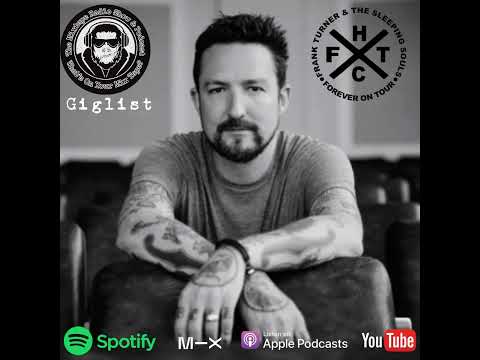
Frank Turner Interview - How He Writes Music and SINGING FOR MY DAUGHTER
Know someone who'd love this clip?
Share it with friends and fellow fans.
Share this clip
Know someone who'd love this clip?
Share it with friends and fellow fans.
🔴 Subscribe for more https://www.youtube.com/user/skinnywristfilms?sub_confirmation=1 ✅ Check out more about me and what I do https://www.kevindurham.com/ Follow me TikTok - https://www.tiktok.com/@thekevindurham Instagram - https://www.instagram.com/thekevindurham X - https://x.com/thekevindurham Facebook - http://facebook.com/thekevindurham The High Priest of the Mosh Pit: A Field Guide to the Frank Turner Phenomenon If rock and roll is a religion, Frank Turner is its most frantic, dehydrated, and enthusiastic evangelist. He is not merely a singer-songwriter; he is a traveling revival tent for the disillusioned, a one-man stamina test, and quite possibly the only person on Earth who can make a song about a cathedral in Winchester sound like a threat to overthrow the government. To witness Frank Turner is to abandon the concept of "chill." There is no "background music" in his discography. Even his ballads are delivered with the intensity of a man trying to explain the plot of a movie over the sound of a jet engine. Born from the ashes of the post-hardcore band Million Dead, Turner did something unprecedented: he took the fury, the spit, and the political rage of punk rock, and he applied it to an acoustic guitar. He realized that you don't need a wall of Marshall stacks to be heavy; you just need to mean every single word you scream until the veins in your neck look like a road map of the M25. The Sonic architecture of Sweat The Frank Turner experience is defined by one substance: sweat. It is the currency of his realm. He trades in calories. His backing band, The Sleeping Souls, are not so much a band as they are a highly drilled special forces unit of folk-punk. They operate with a telepathic tightness, navigating the abrupt tempo changes of songs like "Recovery" and "Get Better" with the precision of a Swiss watch that has been dropped in a pint of lager. Musically, Turner occupies a strange, wonderful no-man's-land. He is too punk for the folk purists (who are terrified by his tendency to stage-dive) and too folk for the punk purists (who are confused by the mandolins). He exists in the "Independent Republic of Frank," a genre where the only rule is that the song must be catchy enough to be sung by a drunk person, but smart enough to be analyzed by a history professor. And oh, the history. Frank Turner is the only rock star who writes "diss tracks" about the Year of Our Lord 1066. In "English Curse," he blames his bad luck on William the Conqueror. In "Sons of Liberty," he lectures on classical liberalism over a skiffle beat. He is a history nerd with a microphone, transforming dusty textbooks into mosh-pit anthems. He makes you want to read a biography of Henry VIII while circle-pitting. The Cult of "I Still Believe" At the center of the hurricane is the message. In an era of irony and detached coolness, Frank Turner is aggressively, unashamedly sincere. His magnum opus, "I Still Believe," is not just a song; it is a secular hymn. When he belts out that "rock and roll will save us all," it isn't a cliché—it’s a desperate plea. He believes in the redeeming power of a G-chord the way a drowning man believes in oxygen. This sincerity breeds a specific kind of chaos at his shows. He doesn't command a crowd; he collaborates with it. He orchestrates "Walls of Hugs" instead of Walls of Death. He demands that you high-five your neighbor. He turns a venue of 5,000 strangers into a temporary family reunion where everyone is shouting about how much they hate getting old ("Photosynthesis") or how much they love their friends ("If Ever I Stray"). It is a collective exorcism of modern anxiety. The Man Who Cannot Stop The most terrifying thing about Frank Turner is his engine. He is the shark of the music industry: if he stops moving, he dies. He is famously chasing the ghost of unending touring, racking up show counts that would kill a lesser mortal. Show #1000, Show #2000, Show #3000—these aren't milestones; they are warning signs of a man possessed. He has played in stadiums, he has played in bedrooms, he has played the opening ceremony of the Olympics, and he has played festivals while on crutches. He is the "Hardest Working Man in Show Business" not for the accolades, but because he seemingly has no other setting. He is a kinetic sculpture of anxiety and joy. He writes songs about the road because the road is the only place he makes sense. Ultimately, Frank Turner is an adrenaline shot to the heart of cynicism. He is a reminder that it is okay to be loud, it is okay to be wrong, and it is okay to wear your heart on your sleeve, even if that sleeve is covered in tattoos and beer. He is the best friend you’ve never met, screaming in your face that you are alive, and that, despite everything, it’s going to be fine.
Francis Edward Turner is an English punk and folk singer-songwriter. He began his career as the vocalist of post-hardcore band Million Dead, then embarked upon a primarily acoustic-based solo career following the band's split in 2005. In the studio and during live performances, Turner is accompanied by his backing band, The Sleeping Souls, consisting of Ben Lloyd, Tarrant Anderson (bass), Matt Nasir and Callum Green (drums).
More about Frank Turner→Added
 3:39
3:39The Band, Prince, intox, Y&T
 1:13:49
The Band of Heathens
 2:24:46
The Band
 5:59
5:59Y&T
 1:00
1:00Frank Turner
 25:59
25:59Frank Turner
 1:29
1:29Frank Turner
 18:47
18:47Frank Turner