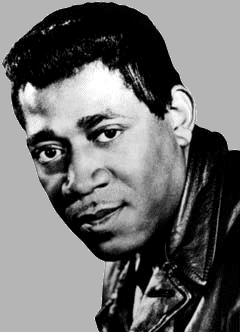
James Carr (singer) — Rare Footage & Clips
James Carr's voice is a masterclass in emotional intensity, a sonic embodiment of the raw, unbridled passion that defines the best of Southern soul. With a career spanning just over a decade, Carr left an indelible mark on the genre, his unique vocal style and interpretive prowess earning him a reputation as one of its greatest practitioners.
One of the most striking aspects of Carr's artistry is his ability to convey the depths of human suffering through song. His voice is capable of conveying a sense of desperation, of anguish, that is nothing short of breathtaking. This is evident in clips such as "You've Got My Mind Messed Up" and "The Dark End of the Street", both of which showcase Carr's remarkable ability to convey the pain and longing that lies at the heart of these classic soul songs.
Carr's influence can be heard in a generation of singers who followed in his footsteps, from Otis Redding to Al Green. His unique vocal style, with its blend of smooth, velvety tones and raw, emotive intensity, has been cited as an inspiration by countless artists. But while Carr's impact on the development of soul music is undeniable, it is his own body of work that remains the true measure of his artistry.
One of the most significant aspects of Carr's career is the fact that he was able to achieve success despite being largely overlooked by the mainstream music industry during his lifetime. Despite releasing a string of critically-acclaimed albums and singles, Carr never quite achieved the level of commercial success that his talents deserved. This is all the more remarkable given the era in which he was active, an era marked by the rise of Motown and other major labels.
Carr's story serves as a powerful reminder of the often-overlooked role that independent labels played in shaping the sound of soul music during its formative years. Artists like Carr, who were able to achieve success outside of the mainstream industry, helped to create a rich and diverse musical landscape that continues to inspire artists today.
The significance of Carr's contributions to music history cannot be overstated. His influence can be heard in everything from classic Southern soul to contemporary R&B, and his unique vocal style has been emulated by countless artists over the years. But beyond his impact on the development of soul music, Carr's legacy is also a testament to the enduring power of art to transcend time and circumstance.
Carr's own words offer a glimpse into the emotional intensity that drove him as an artist. "I'm not just singing," he once said in an interview. "I'm living it." This sense of authenticity, of raw emotional honesty, is what sets Carr apart from his contemporaries and continues to inspire new generations of artists.
One of the most fascinating aspects of Carr's career is the fact that he was able to achieve success despite being largely self-taught as a singer. With no formal training or experience, Carr was forced to rely on his natural talent and instinctive feel for music to guide him through his early years as an artist. This lack of formal training only added to Carr's unique sound, which blended traditional Southern soul with a more experimental approach that pushed the boundaries of what was possible in popular music.
The impact of Carr's music can be seen in clips such as "You've Got My Mind Messed Up", where his raw emotional intensity is perfectly captured on film. The clip shows Carr performing at a small club, surrounded by a handful of devoted fans who are clearly entranced by his performance. As he sings, his voice soaring with anguish and longing, it's clear that this is an artist who is giving everything to his craft.
Carr's legacy extends far beyond his own music, however. His influence can be seen in the work of countless artists who followed in his footsteps, from Al Green to Sam Cooke. And yet, despite his significant contributions to music history, Carr remains a relatively unknown figure outside of specialist circles. This is all the more remarkable given the enduring power and emotional resonance of his music.
One of the most striking aspects of Carr's story is the fact that he was able to achieve success in an era marked by intense racial tension and social upheaval. Despite the challenges he faced, both as a black artist in a predominantly white industry and as a singer who refused to compromise his art for commercial gain, Carr remained committed to his vision.
The significance of Carr's contributions to music history cannot be overstated. His influence can be heard in everything from classic Southern soul to contemporary R&B, and his unique vocal style has been emulated by countless artists over the years. But beyond his impact on the development of soul music, Carr's legacy is also a testament to the enduring power of art to transcend time and circumstance.
In clips such as "The Dark End of the Street", Carr's voice is perfectly captured in all its emotional intensity. The song, with its haunting melody and poignant lyrics, is a powerful reminder of the enduring power of music to capture the human experience. As Carr sings, his voice soaring with anguish and longing, it's clear that this is an artist who is giving everything to his craft.
Carr's legacy continues to inspire new generations of artists, from contemporary R&B singers like Frank Ocean to indie rock bands like The National. His influence can be seen in the work of countless musicians, each of whom has been inspired by his unique vocal style and interpretive prowess.
The impact of Carr's music can also be seen in its enduring popularity among fans of soul and R&B. Despite being released over 50 years ago, songs like "You've Got My Mind Messed Up" and "The Dark End of the Street" continue to be celebrated by audiences around the world for their emotional intensity and raw, unbridled passion.
In conclusion, James Carr's legacy is a testament to the enduring power of art to transcend time and circumstance. His unique vocal style and interpretive prowess have inspired countless artists over the years, and his influence can be heard in everything from classic Southern soul to contemporary R&B.
Curated from public records and music databases.